


“People use tattoos to get over emotional pain, as a form of healing. Tattooing is my way of giving my love back to the world.” - Nathalie Standingcloud
I’ve never been a fan of tattoos. Never wanted one, but the more I learned about tattooing while researching the traditions of the Aniyunwiya (Cherokee) people for my book, We Stand in the Middle, the more I came to see that tattooing is both an art form and a way to make inner truths visible. Within my novel, the tattoo of a bear becomes a symbol of strength, resilience, and an emerging awareness of the importance of reclaiming and educating others about Cherokee culture and traditions.
The Cherokee word for tattoo is u-do-we-lv a-ye-lv, meaning “my name as it is written.” Before the development of their written language (an 85-character syllabary created by Sequoyah between 1809 and 1821) tattoos were used to denote identity, including clan membership and rank, spiritual and personal milestones, and accomplishments by warriors.
More Than Skin Deep
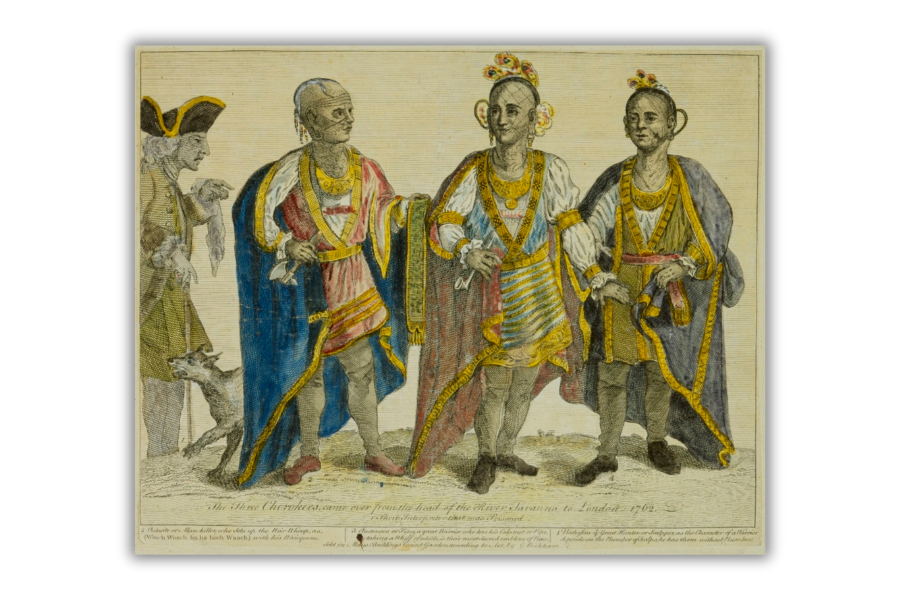
Pictured above are the “Emissaries of Peace,” Ostenaco, Cunne Shote, and Woyi, the three Cherokee diplomats who traveled to London to meet with King George III in 1762 to reaffirm the peace that had recently been negotiated.
As you can see, all three of the emissaries are heavily tattooed. I’d love to know more about what each tattoo signified. The best I can do is tell you how tattoos were created before modern electronic equipment with sterilized needles became available. If you’re squeamish don’t read the next paragraph.
Traditionally, sharp flint, animal bones, or thorns were used to carve the designs into the skin of the face and/or body. After a design was complete, pigment would be rubbed into the open cuts to give the design color. Common tattoos in historic Cherokee society included the moon, stars, mountains, celestial beings, water symbols, snakes, birds, and more.
Modern Day Tattoo Artists
For Nathalie Standingcloud, a talented Cherokee tattoo artist and actress, creating designs and doing the actual tattooing is her way of honoring and preserving a Cherokee tradition, while helping her customers love themselves. “People use tattoos to get over emotional pain - as a form of healing,” Standingcloud says. “When you’re hurting so much on the inside you need something on the outside to bring you back into the present. My aunt taught me that when I touch people with my hands it’s a form of healing or medicine, so I take that seriously.”
Standingcloud has a lot of Cherokee clients come to her to get Cherokee tattoos. “Having a traditional Cherokee tattoo placed on your skin is not just personal expression,” says Ryan Mackey, Cherokee Cultural Specialist. “It’s also tribal expression. It’s solidarity with the concept of decolonizing our society and revitalizing our heritage and traditions.”
Design elements that are unique to Cherokee tattooing include deltoid points, repeated dots, spears and natural motifs such as lightning and bear claws, commonly found on the chest, arms, throat and face.
To learn more about Standingcloud’s work both as an artist and as an actress watch the video below.

Some Final Thoughts
Working on this piece made me wonder if we - as Americans committed to preserving our democracy - could take some lessons from the tattoo artists like Standingcloud. How might we use tattos to resist the unlawful invasion of our cities, violent abductions, and murders of our citizens? No, I am not suggesting that we all go get permanent tattoos, but couldn’t we create a temporary tattoo for ourselves that would symbolize our solidarity and strength? What might those tattoos look like, and how would we apply them?
My answer to that question is taken from my book, We Stand In the Middle in which the legend of the bear clan figures prominently. Bears symbolize strength, wisdom, and protection - and the legend of how the Bear clan was formed is still told often. The members of that clan promised to return to help the other clans when and if they were needed. Below is the temporary Bear Clan tattoo I created. Just click on the image to get your own:

Resources
History of Tattooing (the Smithsonian): https://www.smithsonianmag.com/history/tattoos-worldwide-history-144038580
Tattoos - A Language Beyond Communal Bounds: https://visitcherokeenc.com/blog/tattoos-a-language-beyond-communal-bounds/
Cherokee Almanac: The Emissaries of Peace
Copyright 2026 by Jena Ball. All Rights Reserved.
